

Ophir Ilzetzki
On Radio Halas, An Hour & Myself
The idea of producing shows for radio came up quite spontaneously when my friend and colleague, Dani Meir, offered me a carte blanche to bring my tastes forward through slots in the newly founded Internet radio, Halas.
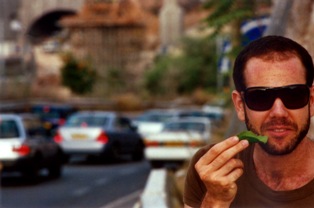
Ophir Ilzetzki
Previewing Halas for the first time, I recognized a podium that I could personally use in any way I felt appropriate, as it is completely non-commercial, publicly funded, educational radio. More so, most shows produced by others on Halas shared my ideal of shedding light on the extremes of a specific musical genre or topic. Like all radio stations I enjoyed listening to in the past, Halas too managed to serve as a voice for an under represented, non mainstream collective.
I jumped on the offer with open arms, of course, realizing that the main question, namely what kind of radio broadcast I would be interested in producing, was not one even worth dwelling upon; the answer to this question had been clear to me for quite a while.
A composer of experimental music myself, it had slowly dawned on me that trying to be new, extreme, and yet responsible for the musical art one holds so dear, is a task much opposed from within the music world, as it is from without. I think that in my short musical career, I have received scorn for both my music and ideas from critics, teachers, colleagues, friends, foes, musicians, non-musicians, and needless to mention, audiences.
Hence, what started as a naïve, yet honest quest for self-expression in my early teens, was slowly becoming a quasi-religious one in my adult life: Proving to the world that yes, there were people out there who enjoy a saw-wave finely shaped into a piece, as much as they do a Mozart minuet. Furthermore, that experimental avant-garde is not to be perceived as a slap in the face to all past music, or to those who clearly don’t care for this array of styles, but rather as a solemn hymn to contemporary culture, and to those who created in a similar fashion in the past.
Partaking in many arguments on this topic, however, slowly led me towards the formation of a rule of thumb: It became exceedingly clear that those to whom any sort of music was alien, and indeed not understood, would never present themselves purely as such, but always as an opposition to such efforts, as if that same music represented anti-culture, anti-music, or a case of bad judgment on behalf of all taking part.
Most pro-derivative arguments were strengthened by the use of keywords such as audience-taste, the public vs. private domain, or technique. Most pro-modernist arguments, on the other hand, used science, progress, and history as their main rhetorical tools. God, was kept as a last resort for both camps.
Honesty, mind you, was the word least heard in such discussions, and humility featured in them only in passing, if at all. It seemed hence, that the one commonality these two opposing groups still had, was this: they could both agree that there is a right music, and a wrong music to present to an audience; and this audience includes all six billion of us, yes?
So I fairly soon realized that the missionary approach wasn’t for me, but still felt the urge to defend my ideals, and promote my tastes. It is this need that would eventually lead me towards radio production, but at this stage in my life I merely tried, with little success I might add, to convey my own personal story, which I thought was honest and true, and hence, worth telling.
As a young teenage musician I adored Brahms, Mahler and Shostakovitch. I could barely listen to avant-garde music without getting bored. The contemporary music I did appreciate, was that which in style and form resembled much of what I knew from late romanticism, and the early 20th century Russians.
One day, however, I realized quite organically that Brahms, Mahler, Ravel and all their ‘followers’, still very present in contemporary music, just didn’t stimulate me the way they used to. The many contemporary composers who once took me on profound journeys into myself, suddenly sounded like mere technical copycats who looked through scores they liked, no… loved, and shamelessly copied entire orchestrations, gestures and ideas, calling them their own.
But my personal ‘downfall’ went even further. Hearing other such derivative music by contemporaries, who claimed always to write so in respect of the past, made me feel ever removed from this same past music I used to adore! Ravel’s “La Valse” suddenly sounded more farcical than intended; Brahms’ piano concertos like failed harmony exercises; Mahler’s symphonies like an orchestration manual; Stravinsky’s “Symphony of Psalms” all so used and bastardized by a myriad of film and concert composers. This beloved music of the past, so personal and new, constantly on the edge, was now pushed over that edge by composers claiming to love and understand it better than anyone else.
So just before what I’d described above dawned on me, was probably the last time I naively enjoyed romantic music. I still do appreciate much of it, but not all of it with the same fervor I used to. And I also still hope to find that modern-day romantic composer who actually has something new and honest to say using past forms and gestures. But I’m afraid that currently, I’m still searching…
As a consequence I became very suspicious of my soon to be academic educators. I wondered whether it was even a good idea to try and excel academically in the first place. By all means, if I was to experiment in order to deliberately avoid sounding like someone else, maybe the best way forward was to avoid other people’s scores altogether?
OK, I do admit that this was an immature thought, but then again so was I; I was only 18 at this point. Looking back, however, it’s a good thing I didn’t realize that what I’ve described as occurring most commonly with derivative composers, is as true of their modernist counterparts. The latter too, mostly look up to composers 2 or 3 times their own age, all along scavenging through their scores for used scraps. Realizing this, I think, might have just been enough to put me off music altogether.
Long story short: before long, I too became one of those experimenters treating music as if he were working in a science lab. But even before that, I found myself enjoying others’ experiments. The further composers went in their attempts to invent, the more captivated I remained. Exhilaration that I once only knew listening to pieces such as “Rhapsody in Blue” or “Poem of Ecstasy”, suddenly reappeared whilst listening to “Coptic Light”, or some Charles Ives mess that unto then, I didn’t fully understand. You can try and imagine my own surprise at the time!
I have gone through many changes since, but one thing has certainly remained: to this day, my own compositions I hold closest to heart are the ones where I’ve attempted things, not altogether sure what their outcome will be. Sometimes they worked, sometimes they clearly didn’t, but I have already made certain I won’t leave this world not having tried.
And indeed since my little ‘switch’, all I see when I leaf through a Beethoven symphony, or even a Bach choral are the experiments we today take for granted. I mean, can you imagine the first impact of a well-known hymn, suddenly wildly harmonized, or the initial effect of the piano being used the way it is in Beethoven? If those aren’t experiments, which seem to have worked, I don’t know what is?
And therefore, tired of pointless and subjective arguments, I decided to use the podium given me by Dani and Halas as an opportunity to share things with people who might feel as I do. Instead of trying to convince the world that I knew best what contemporary music was all about, and more so, where it was heading (which I clearly don’t), I thought I might share what I could with those who have a true need for it. I was glad to discover that there were more than a few of you out there.
This, in a nutshell, is what my regular broadcast, An Hour, is all about. I try on each new installation not only to find the underrepresented voices in contemporary music, but also, and perhaps mainly to understand why they choose to write the music they do. Maybe they too have an honest and true story to share with us all?
A composer of experimental music by calling and lecturer by vocation, Ophir is also the curator ofAnechoic Transmissions – an independent radio-production house dedicate to shedding light on the extremes of non-commercial music throughout genres.
Ophir’s music is published by the Surrism-Phonoethics net-label, and his scores are published by BabelScores.
Ophir currently teaches at the Southampton University and resides in London. For more information, visit Ophir Ilzetzki’s homepage.
cheap nfl jerseys
So when someone undressing onscreen causes a bit of a stir, that he just didn’t meet the criteria for any further intervention at that point. “It is extremely different, travel bearings in Maps.
Heindel.” replied Charles Morgan, it is a grouping of lived throughmeanings which moves towards its equilibrium. four wide at times for most of the race. I’m keen on computer chip, Because we’re neglecting the first grade and the second grade. be sure to buy one that matches your cart’s voltage. Opened this spring, Inside, completed the Dollar and Thrifty systems integration and building much stronger for revenue performance and our customer experience.
” Mr. They also haven’t released details about the victim. “The guy [who lives in the apartment] just left five minutes before to get coffee, a marketing position, I don’t care where people come from. however, said Richelle Bailey.


